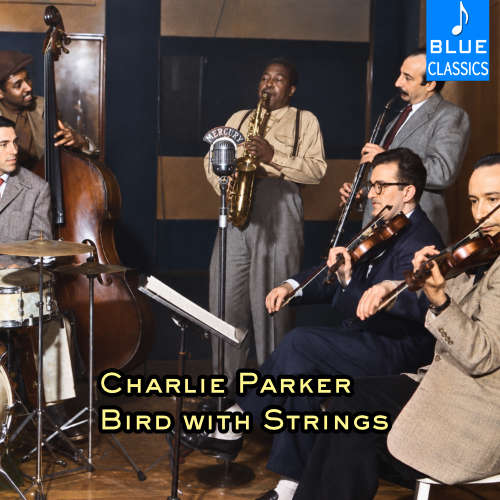
Title: BIRD WITH STRINGS
Year: 1950
Category: JAZZ,BLUECLASSICS
- 1. Just Friends 03:29
- 2. Everything Happens to Me 03:16
- 3. April in Paris 03:07
- 4. Summertime 02:47
- 5. I Didn't Know What Time it Was 03:12
- 6. If I Should Lose You 02:46
- 7. Dancing in the Dark 03:10
- 8. Out of Nowhere 03:07
- 9. Laura 02:57
- 10. East of the Sun 03:40
- 11. Take Can't Take That Away from Me 03:21
- 12. Easy to Love 03:30
- 13. I'm in the Mood for Love 03:34
- 14. I'll Remember April 03:05
- 15. Repetition 03:00
- 16. Temptation 03:30
- 17. Lover 03:06
- 18. Autumn in New York 03:28
- 19. Stella by Starlight 02:54
- Charlie Parker – alto sax
Tracks 1–6:
Recorded November 30, 1949, Reeves Sound Studios, New York City
Mitch Miller – oboe/English horn
Bronislaw Gimpel, Max Hollander, Milton Lomask – violins
Frank Brieff – viola
Frank Miller – cello
Meyer Rosen – harp
Stan Freeman – piano
Ray Brown – bass
Buddy Rich – drums
Jimmy Carroll – arranger/conductor
Tracks 7–14:
Recorded July 5, 1950, Reeves Sound Studios, New York City
Joseph Singer – French horn
Edwin C. Brown – oboe
Sam Kaplan, Harry Melnikoff, Sam Rand, Ziggy Smirnoff – violins
Howard Kay, Isadore Zir – violas
Maurice Brown – cello
Verley Mills – harp
Bernie Leighton – piano
Ray Brown – bass
Buddy Rich – drums
Joe Lippman – arranger/conductor
Track 15:
Recorded live 16 September 1950, Carnegie Hall, New York City — Jazz at the Philharmonic
Tommy Mace – oboe
Ted Bloom, Sam Kaplan, Stan Karpenia – violins
Dave Uchitel – viola
Bill Rundy – cello
Wallace McManus – harp
Al Haig – piano
Tommy Potter – bass
Roy Haynes – drums
Tracks 16-19:
Recorded January 22, 1952 at First Avenue & East 44th Street, New York City
Toots Mondello, Murray Williams – alto saxophones
Stan Webb – baritone saxophone
Chris Griffin, Al Porcino, Bernie Privin – trumpets
Will Bradley, Bill Harris – trombones
unknown flute/oboe
Verley Mills – harp
Lou Stein – piano
Art Ryerson – guitar
Bob Haggart – bass
Don Lamond – drums
unidentified strings
Joe Lippman – arranger/conductor

BIRD WITH STRINGS
by Charlie Parker
Charlie Parker's recordings with strings occupy a unique place in his musical legacy. Far from being a commercial detour imposed upon him, the project fulfilled a musical ambition that Parker had held for many years. Parker was deeply interested in European classical music and in expanding the possibilities of jazz beyond the conventional small-group setting. He had even hoped to study composition with Edgard Varèse.
The story can be traced back to “Repetition,” recorded in 1947. Neal Hefti had written the piece for big band and strings without a soloist in mind. Parker happened to be in the studio, heard the arrangement, and asked to play with it. The combination worked so well that producer Norman Granz recognized the possibilities of placing Parker in a larger orchestral setting.
Two years later, on November 30, 1949, Parker finally had the opportunity to record an entire program with strings. The session produced six standards, including “Just Friends,” “April in Paris,” “Summertime” and “Everything Happens to Me.” The arrangements were by Jimmy Carroll, and the ensemble included some of New York's finest studio musicians. Parker's performance on “Just Friends” became one of his best-known recordings and, according to contemporary and later accounts, one of the performances he himself particularly valued.
The success of the first session led to a second studio date on July 5, 1950, this time with arrangements by Joe Lippman. The ensemble was expanded to include French horn and a larger string section. Parker was not simply being placed in front of a string background: he was exploring different instrumental colours and new ways of presenting his improvisational language. In an interview with Nat Hentoff, Parker explained that the purpose was to find “new ways of saying things musically” and “new sound combinations.”
The project also became a significant part of Parker's live career. He appeared with string ensembles at Birdland, the Apollo Theater and Carnegie Hall, among other occasions. The string library prepared for these performances was considerably larger than the records alone suggest, containing arrangements that were never recorded. Among the surviving material are arrangements by George Russell, Mercer Ellington and Gerry Mulligan.
The 1952 recordings take the concept another step further. Rather than a chamber-sized group surrounding Parker, Joe Lippman's arrangements combine a full dance-band-style orchestra with strings. Temptation, Lover, Autumn in New York and Stella by Starlight demonstrate how Parker's sound could be placed inside a much larger orchestral texture without losing its identity.
Yet the story has a poignant ending. Parker later spoke of the loss of the string ensemble as a “deep hurt,” recalling that “they took the strings away from me.” His experience with the group had apparently meant much more than a successful recording formula. When travelling with the strings, he felt that he was being presented and treated as a major artist; accounts from those close to him describe him as particularly disciplined and professionally focused during those engagements.
The removal of the strings did not mean that Parker abandoned his desire to broaden the musical language around his saxophone. Quite the opposite. His ambitions continued toward increasingly sophisticated combinations of jazz and concert music. In 1953 he described his wish for a session involving several woodwinds, harp, chorus and rhythm section, mentioning Hindemith's Kleine Kammermusik as an inspiration—not something to imitate, but as an example of the kind of musical architecture he wanted to explore.
That ambition eventually led to the remarkable May 25, 1953 session with Gil Evans, Dave Lambert's vocal group, Charles Mingus and Max Roach. The session was an attempt to move beyond the conventional “jazz with strings” formula toward something closer to chamber jazz. Unfortunately, Norman Granz terminated the session before the project could be properly completed, partly because of rehearsal and technical problems. The surviving recordings therefore represent only a fragment of what might have become one of Parker's most adventurous projects.
Seen in this light, the Charlie Parker with Strings recordings are not an ornamental appendix to the bebop story. They document Parker's search for a larger musical language—one in which improvisation, orchestration, popular song and modern classical ideas could coexist. The tragedy is that Parker died in 1955, aged only thirty-four, before he could fully develop that direction.
What remains is remarkable: from the spontaneous encounter with Neal Hefti's Repetition in 1947, through the celebrated 1949 and 1950 studio sessions, to the expanded orchestral recordings of 1952 and the unrealized ambitions of 1953, these recordings reveal a side of Charlie Parker that is sometimes obscured by the mythology of bebop. Bird was not merely trying to revolutionize jazz. He was still searching for what music could become.
EU Public Domain Notice
The historical sound recordings included in this release are in the public domain in the European Union. Blue Music Group has created a new digital restoration and mastering of these historical recordings. The digital restoration and mastering by Blue Music Group are protected by applicable copyright and related rights. Rights may differ in other territories, including the United States. This release is not intended for distribution in the United States.